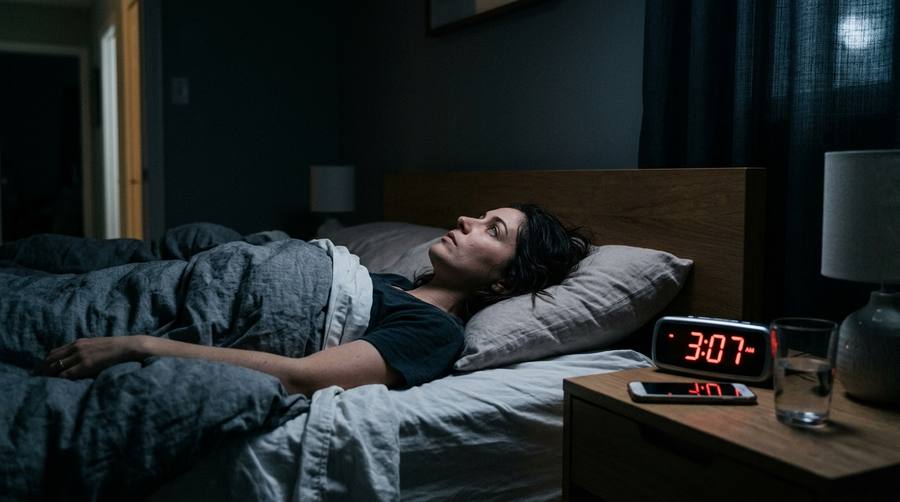
You fall asleep fine. That's not the problem. The problem is 3am. You're awake, and your mind immediately starts running. Tomorrow's meeting. The message you didn't reply to. Something you said three weeks ago. Your alarm isn't for four more hours, but sleep feels unreachable now. You lie there watching the time pass.
This pattern is so common it has a name in clinical literature: middle-of-the-night waking, or sleep maintenance insomnia. And despite how psychological it feels in the moment — all those racing thoughts — the root cause is often physiological.
The cortisol-sleep connection
Cortisol follows a daily rhythm. It's lowest during the first half of the night, when your body is in deep restorative sleep. It then begins rising in the early hours of the morning — a gradual increase that peaks around 30 to 45 minutes after you wake up. This morning cortisol surge is what helps you feel alert and functional.
When you're under chronic stress, this rhythm shifts. The cortisol rise that should happen in the early morning begins too early. Instead of starting its ascent at 5am or 6am, it begins rising at 2am or 3am. That early rise is enough to bring you out of deep sleep. Not fully awake, perhaps, at first — but out of the deep stage where real restoration happens.
Once you're in a lighter sleep stage, any small stimulus — a sound, a half-formed thought — can bring you fully awake. And because your cortisol is already rising, your nervous system is already moving toward alertness. Falling back to sleep becomes genuinely hard.
The thoughts feel like the cause. They're actually the consequence. Your brain is alert because your cortisol is elevated. The thoughts follow from that state, not the other way around.
What makes this pattern self-reinforcing
The 3am waking pattern tends to compound itself. Poor sleep raises cortisol the next day. Elevated cortisol the next day makes sleep worse the following night. You're not imagining that it's getting progressively harder to sleep well. That's exactly what's happening.
This is why behavioral interventions alone — keeping a consistent sleep schedule, avoiding screens, reducing caffeine — help but often don't fully solve the problem. They address the inputs but not the underlying cortisol dysregulation driving the early awakening.
What the research shows about ashwagandha and sleep
Sleep is the most consistently reported early benefit of standardized ashwagandha extract. More consistent, and earlier, than stress or energy changes.
A 2019 study in Medicine (Baltimore) followed 58 adults over 8 weeks. Participants taking 300mg of standardized extract twice daily showed significant improvements in sleep onset latency (time to fall asleep), sleep quality scores, and early morning alertness. The placebo group showed no significant change.
A separate trial specifically focused on adults with insomnia complaints. At 600mg per day of standardized extract, participants showed a 72% improvement rate in sleep quality measures by week 8, versus 29% in the placebo group.
Importantly, the mechanism is not sedative. Ashwagandha doesn't induce sleep the way antihistamines or sleeping pills do. The improvement comes from supporting the body's cortisol regulation — helping the nightly cortisol drop happen properly, and preventing the early morning rise from starting too soon.
Week 2 is usually when sleep changes first. This is earlier than the other benefits. Most people notice they're either falling asleep faster, waking less frequently, or waking up feeling more rested — sometimes all three. The improvement in stress and energy typically follows in weeks 3 to 6.
What to use and what to actually expect
The sleep research uses standardized ashwagandha extract at 300mg to 600mg per day. The withanolide standardization matters — trials used extract standardized to a guaranteed active compound percentage, not raw powder where the content varies unpredictably between batches.
Take it in the morning. Not at night. Despite the sleep benefit, ashwagandha is not a sedative, and the research doesn't show a benefit to taking it close to bedtime. The effect on cortisol regulation works systemically over time, not as an acute sleep aid in the hour before you sleep.
Give it 8 weeks before drawing conclusions. Week 2 is when most people first notice sleep changes. Week 8 is where the full effect is measurable. Stopping at week 3 because the change feels subtle is the most common way to miss the result.
After 8 weeks, take 2 to 3 weeks off before the next cycle. This is not optional. Skipping the break leads to diminishing returns in subsequent cycles as your body adjusts to the constant input.
This article is for informational purposes only. If your sleep disruption is severe, persistent, or accompanied by other symptoms, speak to a doctor. This content is based on published clinical research and is not a substitute for medical advice.