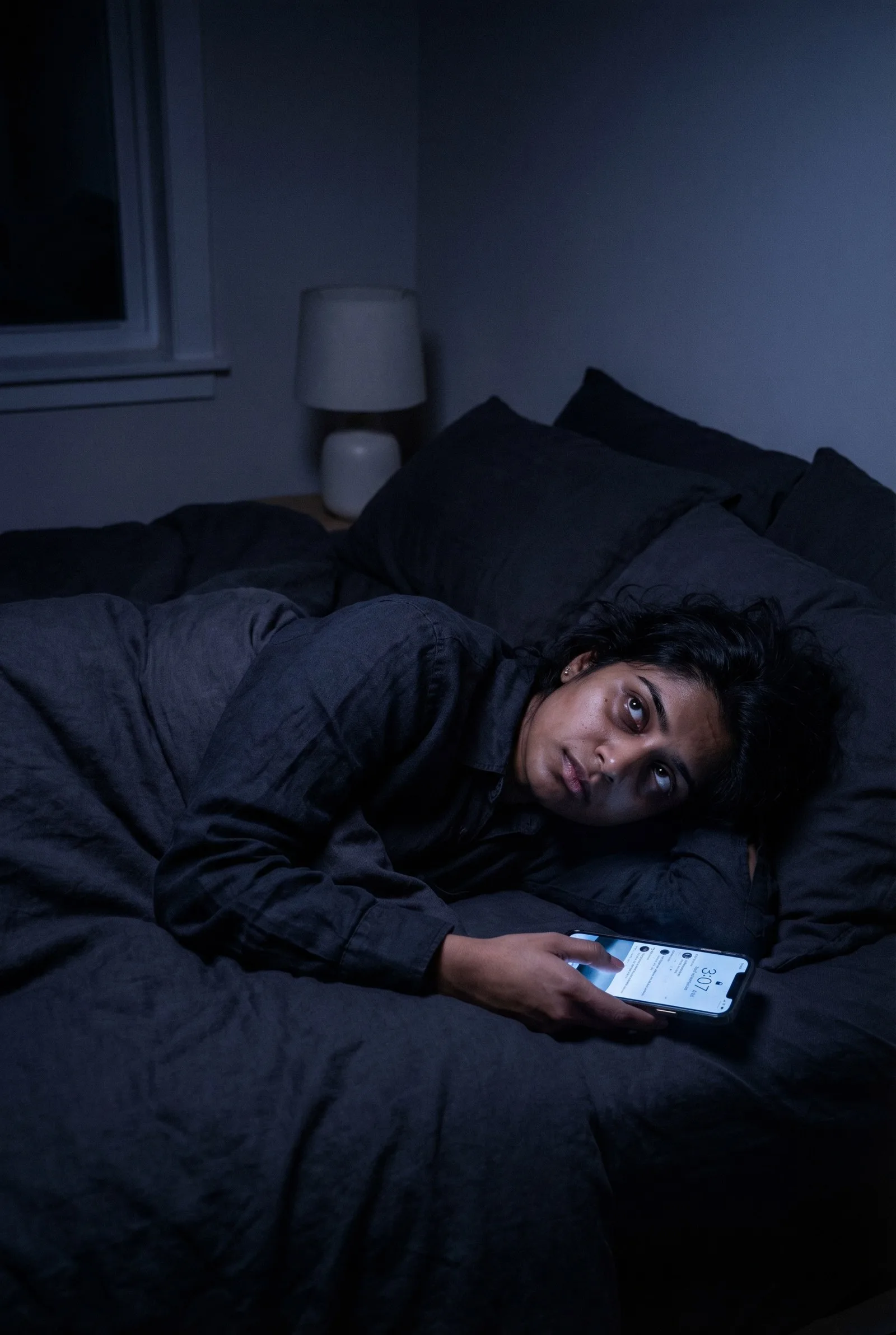
You're tired enough to fall asleep standing up. The whole day you were running on empty. By 9pm you can barely keep your eyes open. You get into bed, close your eyes — and nothing. Your mind starts. The list of things you didn't do. The conversation that's been sitting unresolved. Something that happened months ago that your brain has decided right now is the perfect time to process.
An hour passes. You're still awake. More tired than before, but less able to sleep. This is not insomnia in the classic sense. It has a specific pattern that shows up in clinical sleep research under different names: hyperarousal, exhausted wakefulness, or most accurately, elevated evening cortisol.
Why your body and your brain are contradicting each other
Sleep requires two conditions to happen simultaneously. Your body needs to be physically tired — which you are. And your nervous system needs to be in a state of low arousal — which, if you're experiencing this, it isn't.
Cortisol is the primary arousal hormone. Under normal conditions, it drops steadily through the evening, reaching its lowest point in the first part of the night. This drop is what allows your nervous system to shift into the parasympathetic state — the "rest and digest" mode — that sleep requires.
When you've been managing sustained stress through the day, cortisol doesn't drop on schedule. It stays elevated into the evening. Your body is exhausted — adenosine (the tiredness compound) has been building all day. But your nervous system is still running in partial alert mode. The result is the exact contradiction you experience: physically tired, mentally unable to stop.
This is not anxiety in the clinical sense. You don't need to have an anxiety disorder to experience this. It's a cortisol problem. The anxious thoughts are often a symptom of the elevated arousal state, not the cause of it.
Why sleep hygiene alone often isn't enough
The standard sleep advice is correct as far as it goes. Keep a consistent sleep time. No screens before bed. Dark and cool room. No caffeine after 2pm. These things reduce the incoming stimulation to your nervous system.
But they don't directly address an elevated cortisol baseline. If your HPA axis has been running in overdrive for months, your body's natural cortisol rhythm has been recalibrated around that state. Good sleep habits remove obstacles. They can't independently correct a dysregulated system.
This is why many people find that sleep hygiene improvements help somewhat but don't fully resolve the exhausted-but-wired pattern. The input side is cleaner, but the baseline is still off.
What clinical research on ashwagandha and sleep shows
Sleep quality improvement is the most consistent and earliest reported benefit of standardized ashwagandha extract in clinical trials. More consistent, and faster to appear, than stress reduction or energy improvements.
A study published in PLOS ONE (2020) specifically examined adults experiencing non-restorative sleep. Participants taking 600mg of standardized extract per day showed a 72% improvement rate in sleep quality at 8 weeks. The placebo group showed 29%. Participants reported not just falling asleep faster, but experiencing better sleep depth and feeling more rested on waking.
The mechanism is not sedative. Ashwagandha does not suppress the nervous system. It works by supporting the body's cortisol regulation — helping the evening cortisol drop happen as it should, allowing the nervous system to reach the lower arousal state that sleep requires. The body is then able to do what it was already trying to do. The obstruction is removed rather than the sleep being forced.
The practical difference: A sedative makes you sleep regardless of your cortisol state. Ashwagandha supports your body's ability to naturally reach the state where sleep happens. This is why people who respond to it describe the change as feeling more like their old sleep rather than medicated sleep. The quality is different. Better.
What to expect and when
Sleep is typically the first benefit to appear. Most people who respond to ashwagandha notice a change by week 2. Not always dramatic — sometimes just that they're falling asleep slightly faster, or waking in the night slightly less, or that the first thing they're aware of is their alarm rather than lying awake at 3am.
By week 6 to 8, the change is more consistent. Waking up with something resembling energy rather than just less exhaustion. Being able to get to the end of the day without the full system-crash that sends you to bed only to have your mind race for an hour.
Standardized extract matters. The trials use extract standardized to a guaranteed withanolide content — a clinically studied level. This is the active compound. Without standardization, you're getting an unknown amount of it, and the effect on cortisol regulation is unpredictable. Most cheap ashwagandha on the market is raw powder. Raw powder has no withanolide guarantee.
Dose: 300mg to 600mg per day. Take it in the morning. The sleep benefit comes from systemic cortisol regulation over time, not from taking it close to bedtime.
Cycle: 8 weeks on, then 2 to 3 weeks off. Consistent cycling produces consistent results. Without the break, the effect diminishes over time.
This article is for informational purposes only. If you have a diagnosed sleep disorder or take medication, speak to your doctor before starting any supplement. Content is based on published clinical research and is not medical advice.